Hundapoteket
Slippery Elm (100g)
Slippery Elm (100g)
Couldn't load pickup availability
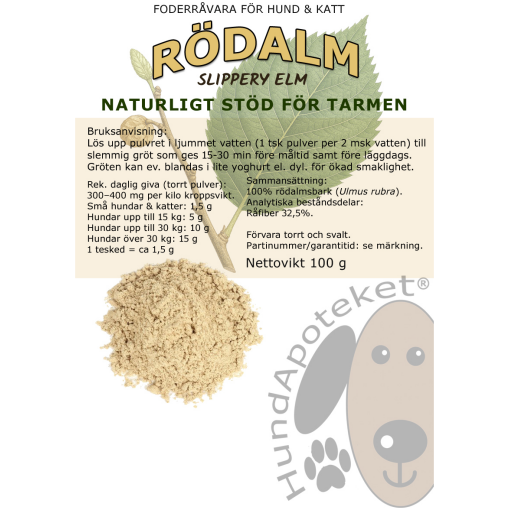
Hundapoteket's Slippery Elm consists of finely ground powder from the inner bark of the American slippery elm tree. What is unique about slippery elm is its natural ability to form a smooth, slimy jelly when the powder is mixed with water. This mucilage is traditionally used to protect and soothe sensitive mucous membranes in the stomach, intestines, and oral cavity.
For best effect, slippery elm should always be given before meals. If given with food, the mucilage can otherwise affect the absorption of nutrients. Slippery elm can also be prepared as a syrup if needed, which allows it to remain longer in the oral cavity.
The powder can be used both internally and externally. For external use, the ready-made syrup is used as a compress on skin that needs protection and relief.
🦴 Specifications
✅ Type: Finely ground bark powder
✅ Ingredient: 100% slippery elm bark (Ulmus rubra)
✅ Net weight: 100 g
Instructions for use
Mix 1 teaspoon of powder with 2 tablespoons of lukewarm water to form a slimy gruel. Give 15–30 minutes before meals and before bedtime. The gruel can be mixed with a little yogurt or similar for enhanced palatability.
Recommended daily dosage (dry powder):
Small dogs and cats: 1.5 g
Dogs up to 15 kg: 5 g
Dogs up to 30 kg: 10 g
Dogs over 30 kg: 15 g
1 teaspoon corresponds to approximately 1.5 g.
For irritation in the oral cavity, slippery elm can be prepared as a syrup by boiling 1–1.5 teaspoons of powder in about 100 ml of water until the consistency thickens. The syrup is given 1/4–1/2 teaspoon up to four times daily. Store in the refrigerator and use within five days.
📌 To consider
Slippery elm should always be given before meals as the mucilage can otherwise affect nutrient absorption. This is a dietary supplement with no medicinal effect and does not replace veterinary care. In case of illness or prolonged discomfort, a veterinarian should always be consulted.